Category: Constitutional Law

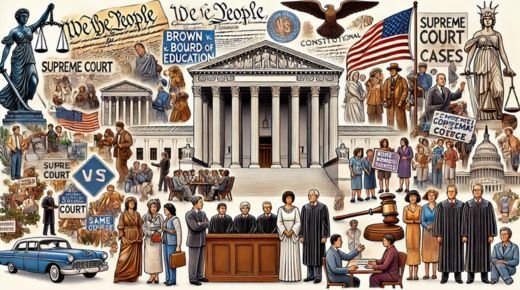
  • Landmark Supreme Court Cases That Changed Constitutional Law

    Landmark Supreme Court Cases That Changed Constitutional Law

    The U.S. Supreme Court plays a pivotal role in interpreting the Constitution and shaping the legal landscape of the nation. Over the years, numerous landmark cases have profoundly impacted constitutional law, altering the course of American history and the rights of its citizens. This article explores some of the most significant Supreme Court cases that have reshaped constitutional law, examining their implications and enduring influence.

    1. Marbury v. Madison (1803)

    Case Summary: Marbury v. Madison is often hailed as one of the most important Supreme Court cases in American history. The case arose when William Marbury sued James Madison, the Secretary of State, for failing to deliver his commission as a justice of the peace. Chief Justice John Marshall’s opinion established the principle of judicial review, which allows the Supreme Court to declare acts of Congress unconstitutional.

    Impact: This decision established the judiciary’s power to review and invalidate legislative and executive actions that conflict with the Constitution. It fundamentally strengthened the role of the Supreme Court and affirmed the importance of judicial review in maintaining the balance of power among government branches.

    2. Brown v. Board of Education (1954)

    Case Summary: Brown v. Board of Education challenged the constitutionality of racial segregation in public schools. The plaintiffs, led by Oliver Brown, argued that segregated schools were inherently unequal and violated the Equal Protection Clause of the Fourteenth Amendment. The Supreme Court, in a unanimous decision, overturned the earlier precedent set by Plessy v. Ferguson, declaring that “separate but equal” was unconstitutional.

    Impact: This landmark decision was a crucial victory for the Civil Rights Movement, as it declared racial segregation in public schools unconstitutional. It set a precedent for further desegregation efforts and civil rights advancements, shaping the course of American social and legal history.

    3. Roe v. Wade (1973)

    Case Summary: Roe v. Wade addressed the constitutionality of state laws restricting abortions. “Jane Roe,” a pseudonym for Norma McCorvey, challenged Texas laws that criminalized most abortions. The Supreme Court, in a 7-2 decision, ruled that the right to privacy under the Fourteenth Amendment extends to a woman’s decision to have an abortion.

    Impact: Roe v. Wade established a woman’s legal right to abortion, fundamentally transforming reproductive rights in the United States. The ruling set a legal precedent that has influenced subsequent debates and legislation regarding abortion and women’s rights.

    4. Miranda v. Arizona (1966)

    Case Summary: Miranda v. Arizona addressed the rights of individuals subjected to custodial interrogations. Ernesto Miranda, who confessed to crimes without being informed of his rights, challenged the admissibility of his confession. The Supreme Court ruled that the Fifth Amendment requires law enforcement to inform individuals of their rights to remain silent and to have an attorney present during interrogations.

    Impact: The decision led to the creation of the “Miranda rights,” which are now a standard procedure in criminal law enforcement. This ruling protects individuals against self-incrimination and ensures fair treatment during custodial interrogations.

    5. Obergefell v. Hodges (2015)

    Case Summary: Obergefell v. Hodges addressed the issue of same-sex marriage. James Obergefell, a plaintiff, challenged Ohio’s refusal to recognize his marriage to his same-sex partner, arguing that it violated the Fourteenth Amendment’s guarantees of equal protection and due process. The Supreme Court ruled that same-sex marriage is a constitutional right under the Fourteenth Amendment.

    Impact: This landmark ruling legalized same-sex marriage nationwide, marking a significant victory for LGBTQ+ rights. The decision affirmed the principle of equality under the law and was a major step forward in the fight for LGBTQ+ civil rights.

    6. Citizens United v. Federal Election Commission (2010)

    Case Summary: Citizens United v. Federal Election Commission dealt with the regulation of political spending by corporations and unions. Citizens United, a nonprofit organization, challenged restrictions on political spending by these entities. The Supreme Court ruled that the First Amendment protects the right of corporations and unions to spend unlimited amounts of money on political campaigns.

    Impact: The decision dramatically changed the landscape of political finance, leading to an increase in the influence of money in politics. It sparked debates about campaign finance reform and the impact of corporate spending on democratic processes.

    7. Loving v. Virginia (1967)

    Case Summary: Loving v. Virginia challenged state laws banning interracial marriage. Richard and Mildred Loving, an interracial couple, were convicted under Virginia’s anti-miscegenation laws. The Supreme Court ruled that such laws were unconstitutional, violating the Equal Protection Clause of the Fourteenth Amendment.

    Impact: This landmark decision invalidated laws prohibiting interracial marriage, affirming the principle of equality and individual rights. It was a significant step toward dismantling racial discrimination and promoting civil rights.

    8. Plessy v. Ferguson (1896)

    Case Summary: Plessy v. Ferguson involved Homer Plessy, an African American who was arrested for sitting in a “whites-only” railroad car. The Supreme Court upheld the constitutionality of racial segregation under the doctrine of “separate but equal,” allowing segregation to persist.

    Impact: Although later overturned by Brown v. Board of Education, Plessy v. Ferguson had a profound impact on American society, legitimizing racial segregation and discrimination for decades. It highlighted the ongoing struggle for civil rights and equality.

    9. United States v. Nixon (1974)

    Case Summary: United States v. Nixon addressed the Watergate scandal and President Richard Nixon’s claim of executive privilege to withhold information. The Supreme Court ruled that the President was not above the law and that executive privilege could not be used to obstruct justice.

    Impact: This decision reinforced the principle that no one, including the President, is above the law. It had a significant impact on the balance of power between the executive branch and the judiciary, affirming the rule of law in the United States.

    10. Bush v. Gore (2000)

    Case Summary: Bush v. Gore resolved the disputed 2000 presidential election results in Florida. The Supreme Court halted a manual recount of votes, effectively awarding the presidency to George W. Bush. The Court ruled that the recount process violated the Equal Protection Clause of the Fourteenth Amendment.

    Impact: This controversial decision concluded one of the closest and most contentious presidential elections in U.S. history. It underscored the role of the Supreme Court in resolving electoral disputes and highlighted the complexities of election law and judicial intervention.

    Conclusion

    These landmark Supreme Court cases have profoundly influenced constitutional law and American society. From establishing judicial review to affirming civil rights and redefining the limits of executive power, these decisions reflect the evolving nature of constitutional interpretation. They serve as pivotal moments in the ongoing dialogue about rights, justice, and the role of the judiciary in shaping the nation’s legal and social landscape. Understanding these cases provides valuable insights into the principles that guide American constitutional law and the enduring impact of the Supreme Court’s decisions.

  • 8 Common Questions About the Impact of Constitutional Amendments


    1. What is a protected change?

    A sacred correction is a proper change or expansion to the U.S. Constitution, permitting it to adjust to new difficulties or cultural movements while saving its fundamental standards.


    1. How do changes affect individual freedoms?

    Corrections frequently grow or explain individual privileges, like the Principal Change (the right to speak freely of discourse) and the Fourteenth Amendment (equivalent insurance and fair treatment). They guarantee assurances line up with developing cultural qualities.


    1. How have changes resolved issues of equity?

    Key changes advancing equity include:

    thirteenth Amendment: Abrogated subjugation.

    fourteenth Amendment: Reliable equivalent assurance under the law.

    fifteenth and nineteenth Corrections: Restricted casting a ballot separation in view of race and orientation, separately.

    Read Also:

    https://elitelawquest.com/10-key-questions-about-individual-rights-under-the-constitution/

    https://elitelawquest.com/6-frequently-asked-questions-about-the-role-of-the-judiciary/

    https://elitelawquest.com/20-questions-to-explore-federal-vs-state-constitutional-powers/

    1. How do corrections influence government structure?

    A few changes change the construction or activity of government, for example,


    twelfth Correction: Changed official political decision methods.

    seventeenth Amendment: Permitted direct appointment of congresspersons.

    22nd Amendment: Restricted presidents to two terms.

    1. How do revisions reflect cultural change?

    Corrections frequently answer shifts in popular assessment or huge occasions. For instance:


    Disallowance (eighteenth Amendment) and its nullification (21st Amendment) reflected changing mentalities toward liquor.

    26th Amendment: Brought the opposing age to 18 during the Vietnam War period.

    1. Which job do changes play in extending a majority rules system?

    Revisions like the fifteenth, nineteenth, 24th (restricting survey charges), and 26th Corrections have widened elector interest, making the vote based process more comprehensive.


    1. Might changes at any point restrict government power?

    Indeed, numerous changes, similar to the Bill of Privileges, unequivocally limit government position to safeguard individual opportunities, for example, the Fourth Amendment’s assurance against outlandish quests.


    1. How do revisions impact current lawful translation?

    Courts frequently depend on revisions to decipher and apply established standards to contemporary issues. For instance, the Fourteenth Amendment has been fundamental to cases on social equality, same-sex marriage, and security.

  • 20 Questions to Explore Federal vs. State Constitutional Powers


    Government Powers

    What are counted powers?

    Listed powers are explicit powers conceded to the central government by the Constitution, like directing highway business and begetting cash (Article I, Segment 8).


    What is the incomparability statement?

    The matchless quality provision (Article VI) lays out that the Constitution, government regulations, and arrangements are the preeminent tradition that must be adhered to, abrogating clashing state regulations.


    What is the job of Congress in government powers?

    Congress orders regulations inside its established power, including directing trade, proclaiming war, and burdening and spending.


    What is the Vital and Legitimate Statement?

    The Fundamental and Appropriate Provision (Article I, Area 8, Proviso 18) gives Congress the adaptability to pass regulations expected to execute its specified powers.

    Read Also:

    https://elitelawquest.com/10-key-questions-about-individual-rights-under-the-constitution/

    https://elitelawquest.com/6-frequently-asked-questions-about-the-role-of-the-judiciary/

    https://elitelawquest.com/8-common-questions-about-the-impact-of-constitutional-amendments/

    What powers are only government?

    Elite powers incorporate announcing war, controlling global exchange, printing cash, and overseeing unfamiliar relations.


    What is government seizure?

    Government acquisition happens when bureaucratic regulations outweigh clashing state regulations, frequently in regions like migration and ecological guideline.


    State Powers

    What are saved powers?

    Held powers are those not appointed to the central government or disallowed to the states, as illustrated in the 10th Amendment. Models incorporate training and nearby policing.


    Will states make their own constitutions?

    Indeed, each state has its own constitution, furnished it doesn’t struggle with the U.S. Constitution.


    What is police power?

    States practice police ability to manage wellbeing, security, ethics, and general government assistance inside their nation.


    Will states manage highway business?

    States can’t direct business between states (highway), yet they can control trade inside their nation (intrastate), as long as it doesn’t struggle with government regulation.


    What powers are elite to states?

    Select state powers incorporate directing races, giving licenses (e.g., marriage, driving), and overseeing nearby legislatures.


    Shared Powers

    What are simultaneous powers?

    Simultaneous powers are shared by both administrative and state legislatures, for example, the ability to burden, construct foundation, and uphold regulations.


    Could states order regulations in areas of government power?

    States can administer in areas of administrative power as long as the national government has not acquired the field and there is no contention.


    How do states and the national government coordinate?

    Participation happens in regions like fiasco reaction, framework advancement, and general wellbeing drives.


    Clashes and Goal

    What happens when state and government regulations struggle?

    Government regulation wins under the matchless quality proviso. Be that as it may, courts frequently resolve questions about whether government or state regulation ought to apply.


    What is double sway?

    Double power alludes to the concurrence of administrative and state legislatures, each working autonomously inside its own purview.


    Will states won’t implement government regulations?

    States can’t invalidate government regulations yet can challenge their defendability in court. In any case, the national government can implement its regulations straightforwardly.


    Legal Understanding

    Which job does the High Court play in government state clashes?

    The High Court deciphers the Constitution to determine debates among administrative and state legislatures, guaranteeing the overall influence is kept up with.


    How has the understanding of government versus state powers advanced?

    The equilibrium of abilities has moved over the long run, with milestone cases like McCulloch v. Maryland (1819) growing government authority and others attesting states’ freedoms.


    General Standards

    For what reason is the division of abilities significant?

    The division of abilities guarantees an equilibrium that forestalls oppression, considers nearby independence, and guarantees that various degrees of government can resolve issues really.

  • 10 Key Questions About Individual Rights Under the Constitution


    1. What are individual privileges under the Constitution?

    Individual privileges are securities and opportunities ensured to individuals by the Constitution. These incorporate privileges like right to speak freely, religion, fair treatment, and equivalent security under the law.


    1. Where are individual freedoms tracked down in the Constitution?

    The Bill of Privileges (the initial ten revisions) is the essential source, alongside different changes like the thirteenth, fourteenth, and fifteenth Corrections. A few rights are likewise suggested through the Constitution’s construction and standards.

    Read Also:

    https://elitelawquest.com/6-frequently-asked-questions-about-the-role-of-the-judiciary/

    https://elitelawquest.com/20-questions-to-explore-federal-vs-state-constitutional-powers/

    https://elitelawquest.com/8-common-questions-about-the-impact-of-constitutional-amendments/

    1. What is the reason for the Bill of Freedoms?

    The Bill of Privileges limits government ability to safeguard people’s opportunities and guarantee that the public authority can’t encroach on specific key freedoms.


    1. What is the right from free discourse’s perspective?

    The Main Alteration safeguards the right to speak freely of discourse, permitting people to offer viewpoints without government oversight, however a few cutoff points exist, like limitations on instigation to brutality or maligning.


    1. What is the right from fair treatment’s point of view?

    The Fifth and Fourteenth Changes ensure fair treatment, guaranteeing fair lawful methodology before the public authority can deny an individual of life, freedom, or property.


    1. What is the right from equivalent security’s perspective?

    The Fourteenth Amendment guarantees that no state will deny any individual equivalent security under the law, safeguarding against segregation by the public authority.


    1. What is the right from protection’s perspective?

    While not unequivocally referenced in the Constitution, the right to protection is gotten from corrections like the First, Fourth, Fifth, and Ninth Changes. It safeguards individual independence, like choices about marriage, family, and substantial independence.


    1. What are insurances against unlawful pursuits and seizures?

    The Fourth Amendment shields people from irrational hunts and seizures, requiring policing acquire warrants in light of reasonable justification by and large.


    1. What are privileges connected with criminal procedures?

    The Constitution gives a few rights, including:


    Right to a lawyer (6th Amendment).

    Right to a fair preliminary (6th Amendment).

    Right against self-implication (Fifth Change).

    Assurance from twofold peril (Fifth Revision).

    1. Could individual privileges at any point be restricted?

    Indeed, privileges are not outright and can be confined to adjust public wellbeing, public safety, or other cultural interests. For instance, free discourse doesn’t safeguard impelling to brutality, and protection privileges might be restricted for convincing government interests.

  • 6 Frequently Asked Questions About the Role of the Judiciary


    1. What is the essential job of the legal executive?

    The legal executive deciphers and applies the law, settle questions, and guarantees equity. It fills in as a mind the leader and official branches by surveying regulations and activities to guarantee they consent to the Constitution.


    1. What kinds of cases do courts deal with?

    Courts handle two principal sorts of cases:


    Common Cases: Debates between people or elements, for example, contract questions, property issues, or individual injury claims.

    Criminal Cases: Situations where the public authority prosecutes people or substances blamed for abusing criminal regulations.

    1. How does the legal executive safeguard individual freedoms?

    The legal executive shields individual privileges by guaranteeing regulations and government activities don’t disregard sacred insurances, like ability to speak freely, fair treatment, and equivalent assurance under the law.

    Read Also:

    https://elitelawquest.com/10-key-questions-about-individual-rights-under-the-constitution/

    https://elitelawquest.com/20-questions-to-explore-federal-vs-state-constitutional-powers/

    https://elitelawquest.com/8-common-questions-about-the-impact-of-constitutional-amendments/

    1. What is legal survey?

    Legal survey is the force of courts to evaluate the defendability of regulations, guidelines, and government activities. This power, laid out in Marbury v. Madison (1803), permits the legal executive to discredit illegal regulations or activities.


    1. How are judges designated or chosen?

    Judges are chosen through various strategies relying upon the locale:


    Government Judges: Delegated by the President and affirmed by the Senate.

    State Judges: Can be chosen by citizens or selected through merit-based frameworks, contingent upon the state.

    1. What is the job of the legal executive in keeping up with the overall influence?

    The legal executive guarantees the partition of abilities by looking into activities of the administrative and leader branches. It forestalls exceed by proclaiming illegal activities invalid, subsequently keeping an arrangement of governing rules.